
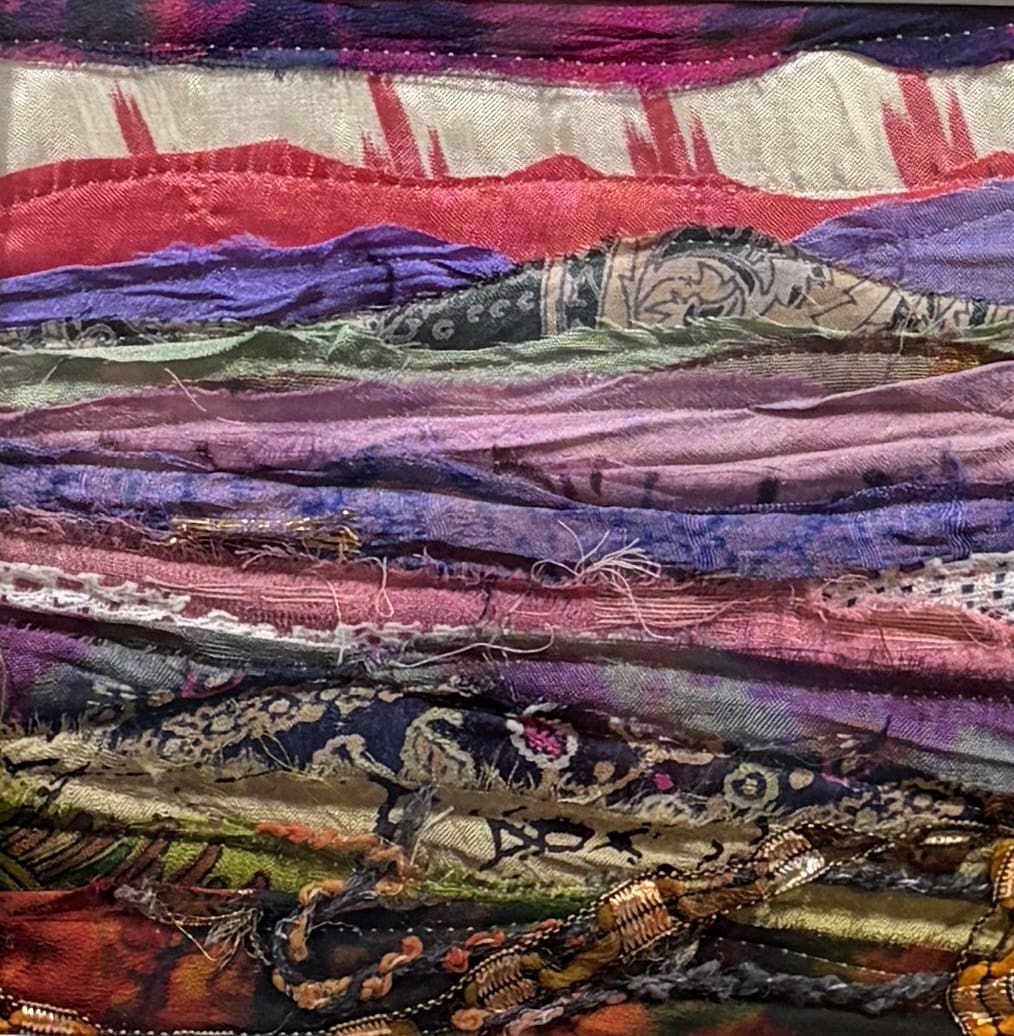
Textiles have a way of inviting you closer. I notice people who stop to look at my work feel an instinct to lean in, to look more carefully, sometimes even to reach out and touch. That response, curious and thoughtful, is very rewarding and sparks many conversations.
My journey with textiles has been a fairly familiar one; I learnt how to make clothes, patchwork, quilting and then fell in love with making art, in particular landscapes and seascapes. After trying watercolours and pastels I decided that I wanted to ‘paint’ with fabric , in particular scraps.
It might sound odd but I think scraps work well with my sense of memory; they make me think about the time and care invested in the textiles over the years: quite different to paint or other medium used to make art I think.
I choose the scraps carefully and love how they become layered, stitched, unpicked, and reworked. Each scrap carries marks of its former ‘life’ as I manipulate and lovingly work them into their future.
Each art piece begins with an idea or a feeling/memory rather than a fixed outcome. I often start with sketches, photographs or sorting through a pile of scraps, sorted for their colour compatibility but I always allow space for the work to change as it develops.
Stitching, layering, and building a scene takes time. It allows me to think, to respond, take a step back and make decisions gradually. The use of a mount is crucial for making those next choices, be it colour, shape, adding textures or even changing a whole part of a landscape
I don’t aim to hide the fraying or make things overly neat. Slight irregularities can produce happy accidents – I try to go with the flow and see what happens – deciding whether it works and if necessary, unpick it later!!
Texture also plays a central role in my practice. It’s often the first thing people notice, even before colour or form. Raised stitches, layered fabric, metallic embellishments can catch the light differently and shift where you look.
I like the idea that a piece can shift depending on where you stand or how the light falls. Textile art doesn’t shout. It reveals itself slowly.
This is my first blog and it is my intention that it becomes a place for me to share more about my practice: the ideas behind the work, inspiration from my international travels and the materials I use – as well as the realities of running a textile art business – about which I’m learning more every day.
It’s also a way to invite you into the process, rather than only showing finished pieces.
If you’re curious to see how these ideas take form, you can explore my current work here on British Craft House.
And if you choose to follow along, I’ll be very pleased to see you here in the future.