
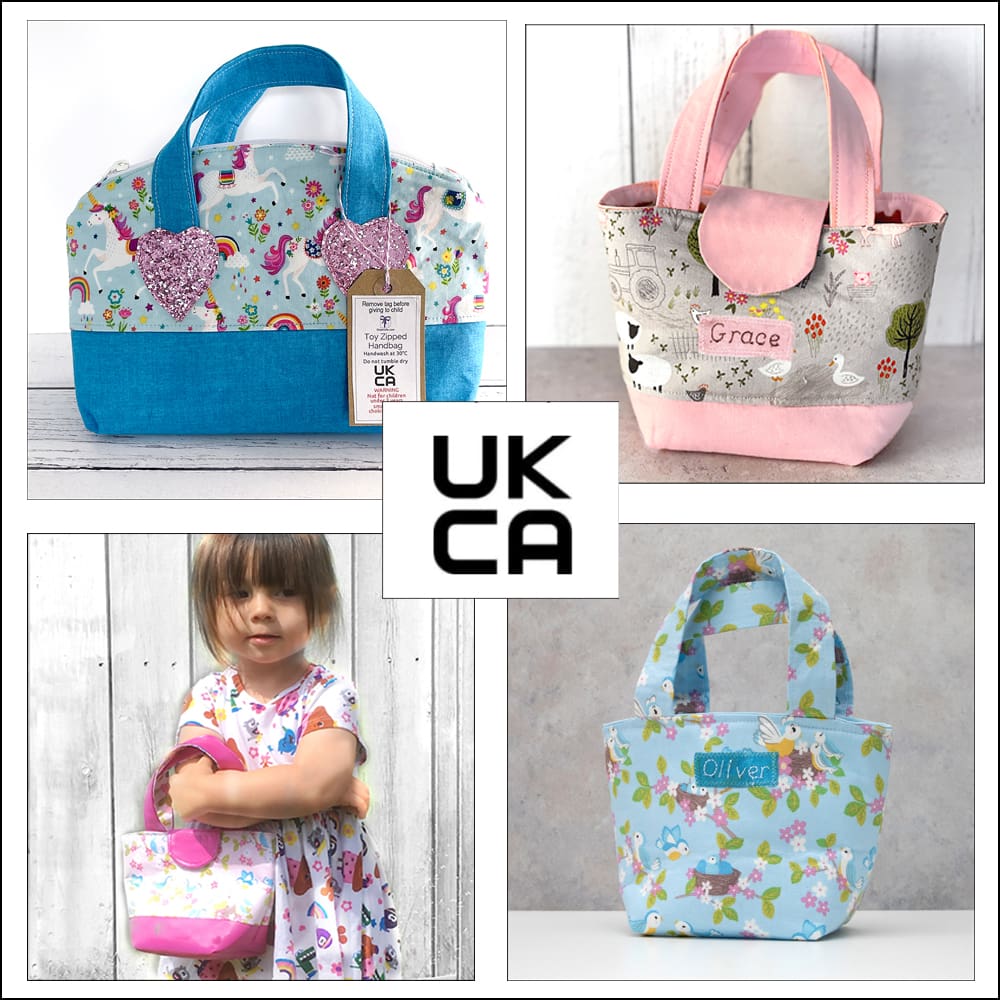
I have been making toy bags for under fives for over ten years. When I started hardly any of those hand making and selling their wares at fairs and markets were aware of the law regarding toy safety. I have watched the craft world slowly wake up to the need for testing and thought a very basic outline about what it is might help explain what it entails.
All soft toys offered for sale in England, Scotland and Wales must be suitable from birth and carry the UKCA mark. This replaced the CE mark which we used before leaving the EU. (The rules for Northern Ireland are slightly different as are those for selling your toy elsewhere outside the UK).
Toy components must have been tested for harmful chemicals and this can only be done in a laboratory which is very costly on a small scale. It is best, therefore, to choose materials for which you can already obtain a testing certificate for EN71-3 and Oeko-tex. This can sometimes be obtained from the manufacturer (if they test for it) or from becoming a member of an organisation such as that listed at the end).
Once you have your “safe” materials, you then have to design your toy to pass the physical tests. Now you become a torturer… You crush your toy, clamp it, hang a specific weight from its weakest parts, drop it from a height, torque twist it and, if it’s still in one piece, set fire to it and video it to calculate the burn rate. Should your victim survive all this unscathed it must go through it all again after a soaking in cold water. Since the fire test often makes the original sample unsuitable for further testing, its often easiesr to start with 2 sample items for each different model of your toy so you go through the process with one soaked (and dry) and a second, un-soaked sample item.
When all the testing is completed and assuming your little treasure passes all the tests, you have to attach a label bearing the UKCA mark, along with your address and the batch number, so the item can be traced back to source if needed.
You finally create a Technical File specifying the shape, size, exact materials, construction method used, etc. You also have to keep a record of who you sell the toy to (just a contact). Finally you sign and keep in your file, so it can be produced if requested by Trading Standards etc., the Declaration of Conformity. All this data must be kept for ten years.
This has been about soft toys. If you want more details about these or other types of toys I suggest you look at https://www.cemarking-handmadetoys.co.uk/ This is a non-profit collective that is a gold mine for all hand crafted toy makers, not just soft toys, who has guided me throughout.